MORE PUBLIC EUROPE
A SET OF EUROPEAN NATIONS WITH SEVERE ASYMMETRIES AND ADHERING TO ECONOMIC TREATIES DOES NOT MAKE A UNITED EUROPE
That said, it is also not possible for the West to isolate itself with tariffs, import quotas, and trade barriers. Today’s Europe is fundamentally different from the one envisioned by its founding fathers, which was built on the principle that the state should play a significant role—even as an entrepreneurial state.
The Europe of today has a privatized architecture designed to serve the interests of a few financial dynasties rather than the collective interests of its citizens.
Why Europe today is completely different from the one envisioned by its founding fathers:
1. The European Union Is Governed by Unelected Representatives.
The European Union is governed by a body whose representatives are not elected by the citizens: the European Commission makes virtually all the key decisions, with the European Parliament merely approving them afterward. The Commissioners are not elected by the people but are appointed by party secretariats, which receive pre-packaged legislative proposals from corporate law firms representing multinational interests. Political parties, in turn, are influenced by major financial groups through moral suasion, donations, and other forms of persuasion.
2. Article 123 of the Lisbon Treaty: Monetary Policy Designed to Benefit Banks.
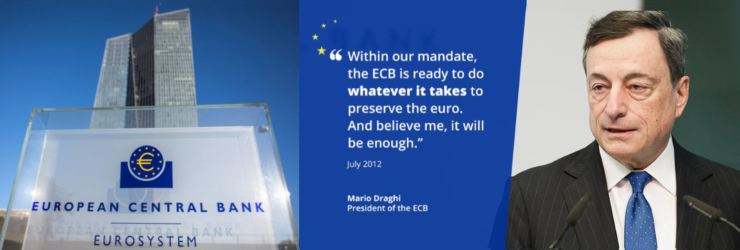
Article 123 of the Treaty on the Functioning of the European Union (alias Lisbon Treaty, alias European Constitution) prohibits the European Central Bank (ECB), the lender of last resort and creator of fiat money, from directly funding European states. Instead:
The ECB creates money out of thin air with a computer click but lends it at 0% or even negative interest rates to the banking system, which is now almost entirely privatized and concentrated in the hands of a select few. These banks then lend the money to states at interest. To pay the interest, states sell shares of public companies, state-owned assets, public properties, raise taxes, and cut public spending.
3. The Lisbon Treaty Lacks Democratic Legitimacy.
The Lisbon Treaty, also known as the European Constitution, should be subordinate to each country’s constitution according to the hierarchy of legal sources, as it was not legitimized through a popular vote. In Italy, the treaty was adopted via a Prime Ministerial decree in August, when most citizens were on vacation, making it unclear what was being signed. In countries where referendums were held—France, Ireland, and Denmark—the European Constitution was rejected by popular vote. Additionally, decisions made by the European Commission should, in theory, be subordinate to the constitutions and governments of each treaty-signing state since sovereignty belongs to the people of each state. For instance: Article 11 of the Italian Constitution stipulates that international disputes must be resolved through diplomacy, never through force or arms. Yet, today, Italy imposes sanctions on countries that were recently its partners and allocates billions of euros to arm nations outside both the European Union and NATO.
4. The European Union Is Not a Political Union Despite its name.
The European Union is not a true political union like the United States of America or a federation or confederation. It is merely a territorial entity on the map comprising sovereign states bound only by economic treaties. The euro is not a single currency; each nation has its own euro with an exchange rate of 1:1 with other countries’ euros. This is evident in: Coins: French euros feature Marianne, German euros the eagle, Italian euros Leonardo’s Vitruvian Man. Banknotes: The serial number on each banknote corresponds to the specific state that issued it via its national mint. Fiscal systems: Each treaty member has its own taxation and fiscal policy. Tax havens, triangular arrangements, and offshore practices such as the “Dutch Sandwich” are legally permitted, allowing countries to evade their own fiscal systems. Military systems: Each country has its own military and law enforcement. Thus, the term “United Europe” is semantically improper, resembling more a deliberate euphemism or even an antiphrasis, as the reality starkly contrasts with the idea of unity.
In essence, today’s Europe prioritizes privatized interests, serving the agendas of a few financial dynasties rather than the collective good of its citizens.
Authors: Altiero Spinelli, Ernesto Rossi, Eugenio Colorni
Original title: “For a Free and United Europe”
Introduction to the Summary
The Ventotene Manifesto (1941) is one of the founding documents of modern European identity.
Written during the darkness of Fascist rule by political prisoners Altiero Spinelli, Ernesto Rossi, and Eugenio Colorni, it envisioned not only the end of dictatorships, but the birth of a new political order: a federal, democratic, and socialist Europe. More than a historical document, the manifesto remains a radical and lucid blueprint.It goes beyond slogans, calling for:
– The abolition of absolute national sovereignty,
– The federal union of European states with shared institutions,
And even the nationalization of monopolies and strategic industries — a vision of economic justice often forgotten or misunderstood by contemporary “progressive” narratives.
This summary distills the core ideas of the manifesto, revealing the courage and clarity of its authors, and reminding us that real democracy requires more than elections:
It requires structure, solidarity, and sovereignty shared wisely.
The Ventotene Manifesto – Summary (1941)
I. The Crisis of Modern Civilization
Modern civilization was founded on the principle of individual liberty, which has been betrayed by nationalism and the rise of totalitarian states. The ideology of national sovereignty has led to a logic of domination and war, reducing citizens to mere instruments of state power.
Dictatorships, supported by economic and political elites, have suppressed every form of freedom—from the press to education, from science to spirituality. Absolute national sovereignty is seen as the main obstacle to peace, equality, and human progress.
II. Post-War Tasks – The European Union
The defeat of Nazism and Fascism will not automatically lead to a peaceful and free Europe.
A key task is to abolish the division of Europe into sovereign nation-states.
A European Federation is the only path to lasting peace, overcoming nationalism and guaranteeing liberty. Such a federation would establish common institutions, a shared military force, integrated economic systems, and republican forms of government in all member states. It would not be a single European state, but a union of free and autonomous states, capable of working together in solidarity.
III. The Reform of Society
The authors call for a European socialist revolution, not driven by dogma, but by practical reason.
The goal is not to abolish private property as a principle, but to subject economic power to democratic control, ensuring that it serves the common good. Key proposals include:
– Nationalization of monopolies and strategic industries;
(major natural monopolies, energy companies, steel industries, banks, etc.)
– Agrarian and industrial reforms in favor of workers;
– Equal access to public education;
– Universal social security without humiliation;
– True trade union freedom (beyond corporatist control);
– A secular state, free from clerical privilege.
IV. Revolutionary Situation: Old and New Currents
The fall of totalitarian regimes will open the door to democratic resurgence—but also confusion and danger. Traditional democratic forces may prove too weak and indecisive;
Communist forces, if tied to external powers like the USSR, may reproduce new forms of authoritarianism. What is needed is a new European revolutionary party, rooted in the working class and intellectuals, able to build a truly democratic and federal political order. It must unite all progressive forces under a clear vision: liberty, solidarity, and the creation of a peaceful and just Europe.
Conclusion
The Ventotene Manifesto is not just a political program; it is a vision of civilization reborn.
It calls for a federal, socialist, and democratic Europe, as a bulwark against tyranny and a hope for future generations.
The development model of the time was the one promoted by Enrico Mattei, according to which the large natural monopolies and strategic companies had to be owned by the State.
In the post-war period, all the main European countries, including Great Britain, France and Italy.
In the post-war period, the model of the Third Way was developed in Italy, also called the “Entrepreneur State” due to the fact that the State held the golden share of strategic companies, and the rest was distributed equally through widespread shareholding. In particular, companies that necessarily operated under a monopoly regime – in Italy, energy, telephone, communications (transport and telecommunications) companies – had to be majority-owned by the public. Politics had the upper hand over finance because it was the head of the Sovereign Funds. In Italy, IRI, at the time of its destruction by privatization, was worth over 44% of the Italian GDP, not counting the related industries.
The precondition is that the true European Political Union is created: that is, unification of the fiscal, electoral, legislative and judicial systems. By providing the European Parliament with decision-making power, which we remember today is in the hands of the European Commission, made up of people not elected by the citizens. Without this precondition, the National Champions of National Sovereign Funds can compete unilaterally outside Europe, and make agreements with other non-European countries.